



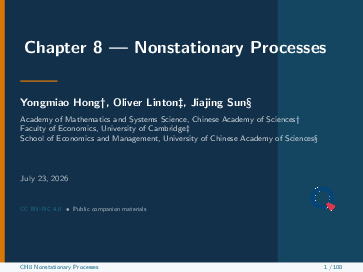
Chapter 8: Nonstationary Processes (Slides) (pdf)
Chapter 8: Nonstationary Processes
-
- 0 Rating
- 0 Reviews
- 5 Students Enrolled
Chapter 8: Nonstationary Processes
Slides for Chapter 8 “Nonstationary Processes” from Hong, Linton, and Sun, Econometrics and Time Series Methods: Theory, Applications, and R Implementation. The slides introduce nonstationary time series, unit roots, and trends, with applications to macroeconomic and financial data.
-
- 0 Rating
- 0 Reviews
- 5 Students Enrolled
Courselet Content
2 components
|
|
1.96 M | |
|
Chapter 8: Nonstationary Processes (Slides) (video)
|
61 min |
Requirements
- Good background in calculus, linear algebra, and introductory probability and statistics. Prior exposure to stationary time series models (e.g., ARMA from earlier chapters) is recommended. Basic R experience is helpful for implementing unit root tests and transformations.
General Overview
Description
Chapter 8
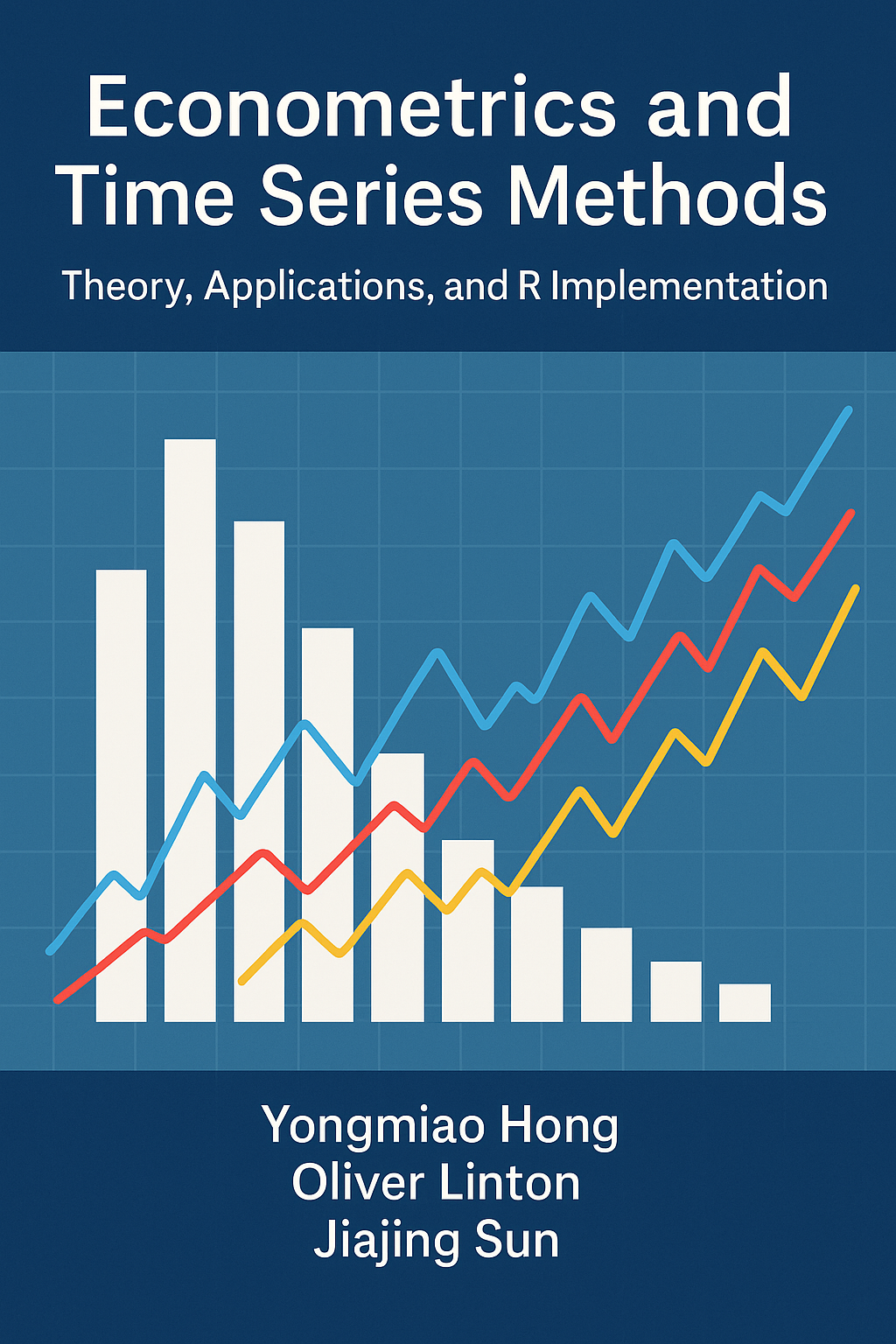
These slides accompany Chapter 8 (“Nonstationary Processes”) of the book
Yongmiao Hong, Oliver Linton, Jiajing Sun
Econometrics and Time Series Methods: Theory, Applications, and R Implementation.
The slides provide a systematic introduction to nonstationary time series, focusing on processes whose statistical properties evolve over time. They contrast stationary and nonstationary behavior and explain why nonstationarity is central to macroeconomic and financial time series analysis. Core topics typically include deterministic and stochastic trends, random walks and integrated processes, unit roots, and the distinction between trend–stationary and difference–stationary models. The slides also discuss implications of nonstationarity for regression analysis—such as spurious regression—and show how transformations (e.g., differencing and detrending) can be used to obtain models suitable for valid inference and forecasting.
Consistent with the book’s emphasis on integrating theory, applications, and computation, the slides link the formal theory of nonstationary processes with practical implementation in R. They illustrate how to visualize and diagnose nonstationarity, implement standard unit root tests, transform data appropriately, and interpret empirical results in applied work. The material is suitable for advanced undergraduate and graduate teaching and can be directly used or adapted by instructors.
Unless otherwise indicated, the slides are shared under the Creative Commons Attribution–NonCommercial 4.0 International License (CC BY-NC 4.0). Readers and instructors who wish to request the LaTeX source files or provide feedback are welcome to contact us at jiajing.sun@gmail.com.
Courses that include this CL
Recommended for you


Meet the instructors !
