



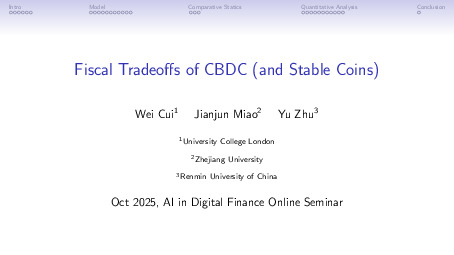
Fiscal Tradeoffs of CBDC (and Stable Coins) (pdf)
Fiscal Tradeoffs of CBDC (and Stable Coins)
-
- 0 Rating
- 0 Reviews
- 4 Students Enrolled
Fiscal Tradeoffs of CBDC (and Stable Coins)
This presentation investigates the **fiscal implications of Central Bank Digital Currencies (CBDCs) and stablecoins**, emphasizing their role as new forms of short-term government liabilities. The authors argue that—when viewed through the lens of the **consolidated government budget constraint**—both CBDCs and stablecoins have comparable fiscal consequences, since they compete with bank deposits and influence the banking sector’s lending capacity. Building on the **CBDC model of Chiu et al. (2023)**, the study integrates government finance, bank competition, and household portfolio choices to examine how CBDC issuance interacts with **taxation, debt financing, and credit creation**. The central questions are whether CBDC issuance can yield **net fiscal benefits**, how it affects lending and inflation, and how optimal issuance levels depend on financial structure and policy regimes. Through analytical derivation and quantitative calibration to the **2022 U.S. economy**, the results highlight an **optimal CBDC level** that raises roughly **0.53 percent of GDP** (≈ $122 billion), stimulates output via deposit-creation channels, and yields stronger expansionary effects than conventional debt financing. The paper concludes that the **degree of banking competition** critically shapes the magnitude of these fiscal and macroeconomic trade-offs.
-
- 0 Rating
- 0 Reviews
- 4 Students Enrolled
Courselet Content
1 components
|
|
792.34 K |
Requirements
- https://quantinar.com/course/540/multivariate-statistical-analysis?q=mva
General Overview
Description
1️⃣ Topic: The paper studies fiscal trade-offs of Central Bank Digital Currency (CBDC) and stablecoins as alternative short-term government liabilities.
2️⃣ Motivation: With CBDC pilots in China, Brazil, and others—and contrasting U.S. executive orders (Biden 2022 vs. Trump 2025)—the fiscal role of such digital assets is now central to policy debates.
3️⃣ Core view: From a consolidated public balance-sheet perspective, both CBDC and stablecoins are government-backed instruments that compete with deposits and affect bank lending.
4️⃣ Model base: Builds on Chiu et al. (2023) with households, firms, banks, and a fiscal authority issuing CBDC, debt, and distortionary taxes.
5️⃣ Mechanisms: CBDC acts as a substitute (or superior) to deposits for payments; its issuance alters deposit creation, loan supply, and inflation.
6️⃣ Fiscal channels: Financing government spending through CBDC versus debt changes seigniorage, deposit competition, and tax requirements.
7️⃣ Analytical results: An interior optimum for CBDC provision exists that minimizes taxes and balances crowding-out (of deposits) with crowding-in (of credit).
8️⃣ Quantitative calibration: For the 2022 U.S. economy, optimal CBDC equals ≈ 11.25 % of output, crowding out ~25 % of deposits and stimulating ~0.53 % of GDP (≈ $122 Bn).
9️⃣ Policy insight: CBDC financing is more expansionary than debt or pure money financing due to its direct pass-through to deposit and lending rates.
🔟 Conclusion: The strength of banking competition and regulatory constraints (e.g., Basel III) crucially determine CBDC’s fiscal effectiveness and optimal scale.
Recommended for you









Meet the instructors !
