



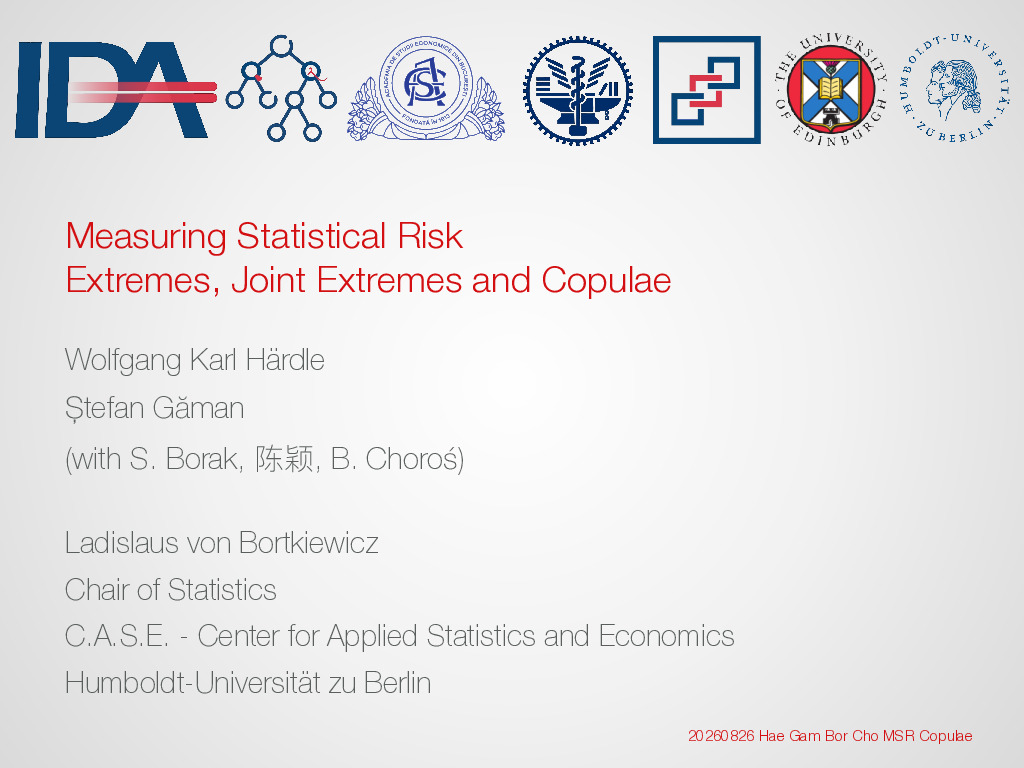
Copulae MSR (pdf)
Copulae MSR
-
- 0 Rating
- 0 Reviews
- 2 Students Enrolled
Copulae MSR
This presentation introduces copula-based methods for modeling joint tail risk and Value-at-Risk (VaR) in multivariate financial data, addressing the shortcomings of traditional multivariate normal risk models. It develops an adaptive, time-varying copula estimation framework using Local Change Point (LCP) detection to track shifts in dependence structure, illustrated with simulated Clayton copula scenarios
-
- 0 Rating
- 0 Reviews
- 2 Students Enrolled
Courselet Content
1 components
|
|
12.79 M |
Requirements
- Statistics
General Overview
Description
The presentation gives an overview of dependence between financial assets, focusing on joint extreme events that heighten portfolio risk during stressed market conditions, illustrated with return data from Mercedes-Benz and Volkswagen. It explains why traditional multivariate normal assumptions underlying methods like RiskMetrics fall short, since they cannot capture heavy tails, asymmetric dependence, or frequent joint extremes, and introduces copulae—via Sklar's theorem—as a way to separate marginal distributions from the pure dependence structure. It then presents several copula families, including Gaussian, Frank, Gumbel-Hougaard, Ali-Mikhail-Haq, and Clayton copulas, comparing their capacity to model upper- or lower-tail dependence, alongside estimation approaches such as Full Maximum Likelihood, Inference for Margins, and Canonical Maximum Likelihood. A central contribution is an adaptive estimation method using Local Change Point detection, which identifies the largest time window over which the copula's dependence parameter can be treated as stable, improving on fixed moving-window Value-at-Risk estimation. The presentation concludes with simulation studies on a 6-dimensional Clayton copula, testing both sudden jumps and gradual shifts in dependence, and showing that the adaptive method detects regime changes with measurable delay, reacting faster to upward than downward jumps.
Courses that include this CL

Recommended for you


Meet the instructors !

About the Instructor
Wolfgang Karl HÄRDLE attained his Dr. rer. nat. in Mathematics at Universität Heidelberg in 1982 and in 1988 his habilitation at Universität Bonn. He is Ladislaus von Bortkiewicz Professor of Statistics at Humboldt-Universität zu Berlin and the director of the Sino German Graduate School (洪堡大学 + 厦门大学) IRTG1792 on “High dimensional non stationary time series analysis”. He directs IDA Institute for Digital Assets,
University of Economic Studies, Bucharest, RO. His research focuses on data analytics, dimension reduction and quantitative finance. He has published over 30 books and more than 300 papers in top statistical, econometrics and finance journals. He is highly ranked and cited on Google Scholar, REPEC and SSRN. He has professional experience in financial engineering, S.M.A.R.T. (Specific, Measurable, Achievable, Relevant, Timely) data analytics, machine learning and cryptocurrency markets. He has created the www.quantlet.com platform, a cryptocurrency index, CRIX www.royalton-crix.com He is 玉山学者 (Yushan Scholar), web page hu.berlin/wkh