



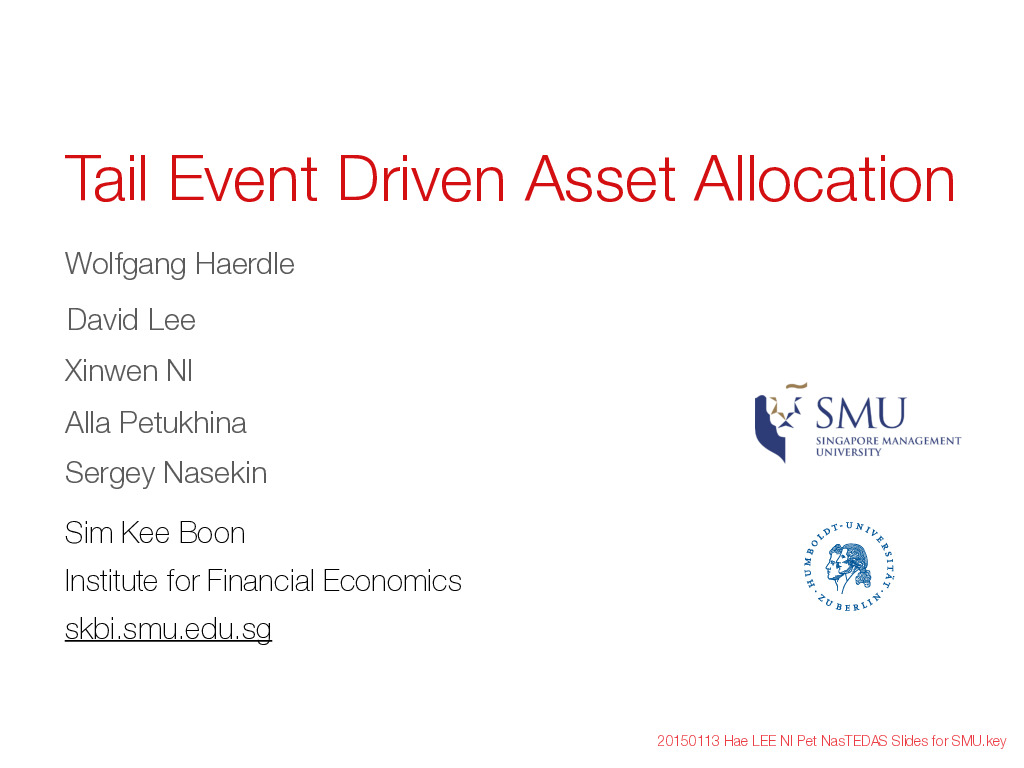
TEDAS Tail Event Driven ASset allocation (pdf)
TEDAS Tail Event Driven ASset allocation
-
- 0 Rating
- 0 Reviews
- 1 Students Enrolled
TEDAS Tail Event Driven ASset allocation
TEDAS Tail Event Driven ASset allocation
-
- 0 Rating
- 0 Reviews
- 1 Students Enrolled
Courselet Content
2 components
|
|
2.61 M |
Requirements
- good MVA k knowledge
General Overview
Description
In this study, we develop a two-step asset allocation strategy that identifies the tail risk of a benchmark asset and uses multi-moment dynamic portfolio selection to account for possible conditional non-normality of portfolio returns. The TEDAS - Tail Event Asset Allocation strategy is based on the non-positive Lasso adaptive quantile regression method which captures negative "tail events" for selected benchmark assets. Dynamic conditional multi-moment investor risk and utility measures are introduced and used to perform portfolio selection. This procedure assumes neither joint nor marginal normality of assets' returns and incorporates dynamic multivariate portfolio skewness and kurtosis statistics into portfolio optimization. The TEDAS strategy is tested for major international markets and demonstrates superior performance compared to the market benchmark and naive allocation.
Recommended for you

Meet the instructors !

About the Instructor
Wolfgang Karl HÄRDLE attained his Dr. rer. nat. in Mathematics at Universität Heidelberg in 1982 and in 1988 his habilitation at Universität Bonn. He is Ladislaus von Bortkiewicz Professor of Statistics at Humboldt-Universität zu Berlin and the director of the Sino German Graduate School (洪堡大学 + 厦门大学) IRTG1792 on “High dimensional non stationary time series analysis”. He directs IDA Institute for Digital Assets,
University of Economic Studies, Bucharest, RO. His research focuses on data analytics, dimension reduction and quantitative finance. He has published over 30 books and more than 300 papers in top statistical, econometrics and finance journals. He is highly ranked and cited on Google Scholar, REPEC and SSRN. He has professional experience in financial engineering, S.M.A.R.T. (Specific, Measurable, Achievable, Relevant, Timely) data analytics, machine learning and cryptocurrency markets. He has created the www.quantlet.com platform, a cryptocurrency index, CRIX www.royalton-crix.com He is 玉山学者 (Yushan Scholar), web page hu.berlin/wkh