



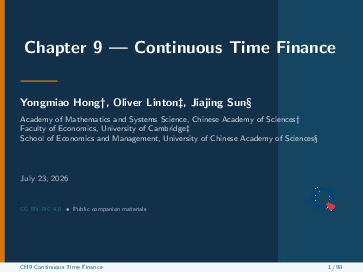
Chapter 9: Continuous-Time Finance (Slides) (pdf)
Chapter 9: Continuous-Time Finance
-
- 0 Rating
- 0 Reviews
- 4 Students Enrolled
Chapter 9: Continuous-Time Finance
Slides for Chapter 9 “Continuous-Time Finance” from Hong, Linton, and Sun, Econometrics and Time Series Methods: Theory, Applications, and R Implementation. The slides introduce continuous-time models for asset prices and interest rates using stochastic calculus, with applications to pricing and risk management.
-
- 0 Rating
- 0 Reviews
- 4 Students Enrolled
Courselet Content
2 components
|
|
681.23 K | |
|
Chapter 9: Continuous-Time Finance (Slides) (video)
|
70 min |
Requirements
- Strong background in calculus and linear algebra, plus introductory probability and statistics. Some prior exposure to discrete-time time series or financial economics is recommended. Familiarity with R is helpful for simulating diffusion processes and implementing pricing examples.
General Overview
Description
Chapter 9
These slides accompany Chapter 9 (“Continuous-Time Finance”) of the book
Yongmiao Hong, Oliver Linton, Jiajing Sun
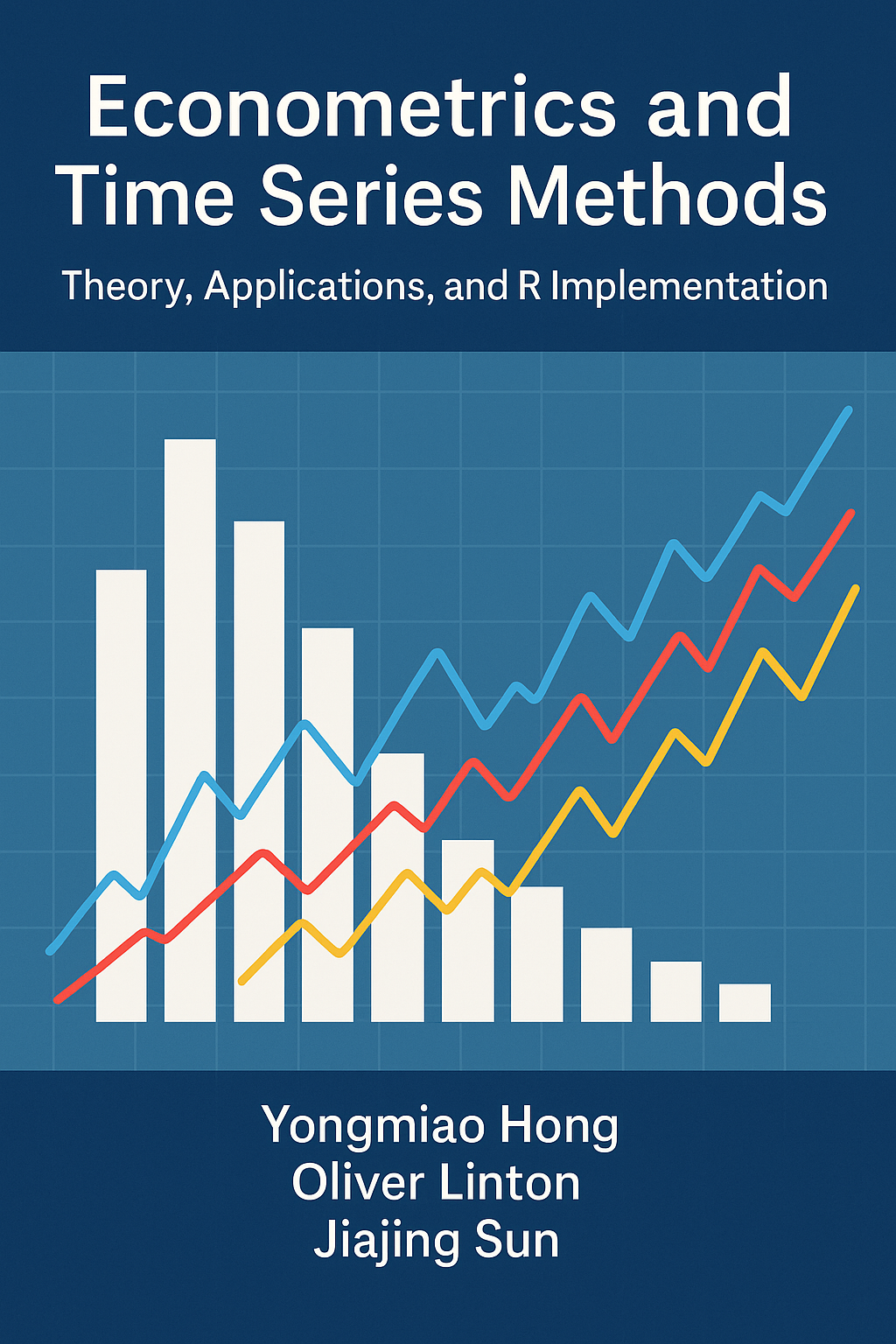
Econometrics and Time Series Methods: Theory, Applications, and R Implementation.
The slides provide an introduction to continuous-time methods in finance, emphasizing how stochastic calculus and diffusion models are used to describe asset prices and interest rates. They typically review Brownian motion and stochastic differential equations, introduce Itô’s lemma, and show how continuous-time models arise as limits of discrete-time processes. Core topics often include the modeling of stock prices with geometric Brownian motion, martingale and no-arbitrage principles, risk-neutral valuation, and the derivation of benchmark pricing formulas such as the Black–Scholes model. The slides may also touch on term-structure modeling, instantaneous interest rates, and related applications in derivative pricing and portfolio management.
In line with the book’s integration of theory, applications, and computation, the slides connect the continuous-time theory with practical implementation in R. They illustrate how to simulate diffusion processes, approximate continuous-time dynamics with discrete-time schemes, and apply these tools to pricing and risk analysis in empirical work. The material is suitable for advanced undergraduate and graduate teaching and can be directly used or adapted by instructors.
Unless otherwise indicated, the slides are shared under the Creative Commons Attribution–NonCommercial 4.0 International License (CC BY-NC 4.0). Readers and instructors who wish to request the LaTeX source files or provide feedback are welcome to contact us at jiajing.sun@gmail.com.
Courses that include this CL
Recommended for you
Meet the instructors !
