



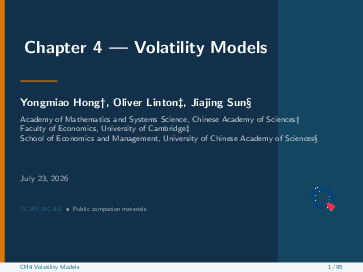
Chapter 4: Volatility Models (Slides) (pdf)
Chapter 4: Volatility Models
-
- 0 Rating
- 0 Reviews
- 7 Students Enrolled
Chapter 4: Volatility Models
Slides for Chapter 4 “Volatility Models” from Hong, Linton, and Sun, Econometrics and Time Series Methods: Theory, Applications, and R Implementation. The slides introduce ARCH/GARCH-type models for time-varying volatility in financial time series, covering key concepts, estimation, and forecasting.
-
- 0 Rating
- 0 Reviews
- 7 Students Enrolled
Courselet Content
2 components
|
|
535.52 K | |
|
Chapter 4: Volatility Models (Slides) (video)
|
75 min |
Requirements
- Solid background in basic calculus, linear algebra, and introductory probability and statistics. Familiarity with linear regression and univariate/multivariate time series analysis (Chapters 1–3) is recommended. Basic R experience is helpful for following the implementation and examples in financial applications.
General Overview
Description
Chapter 4
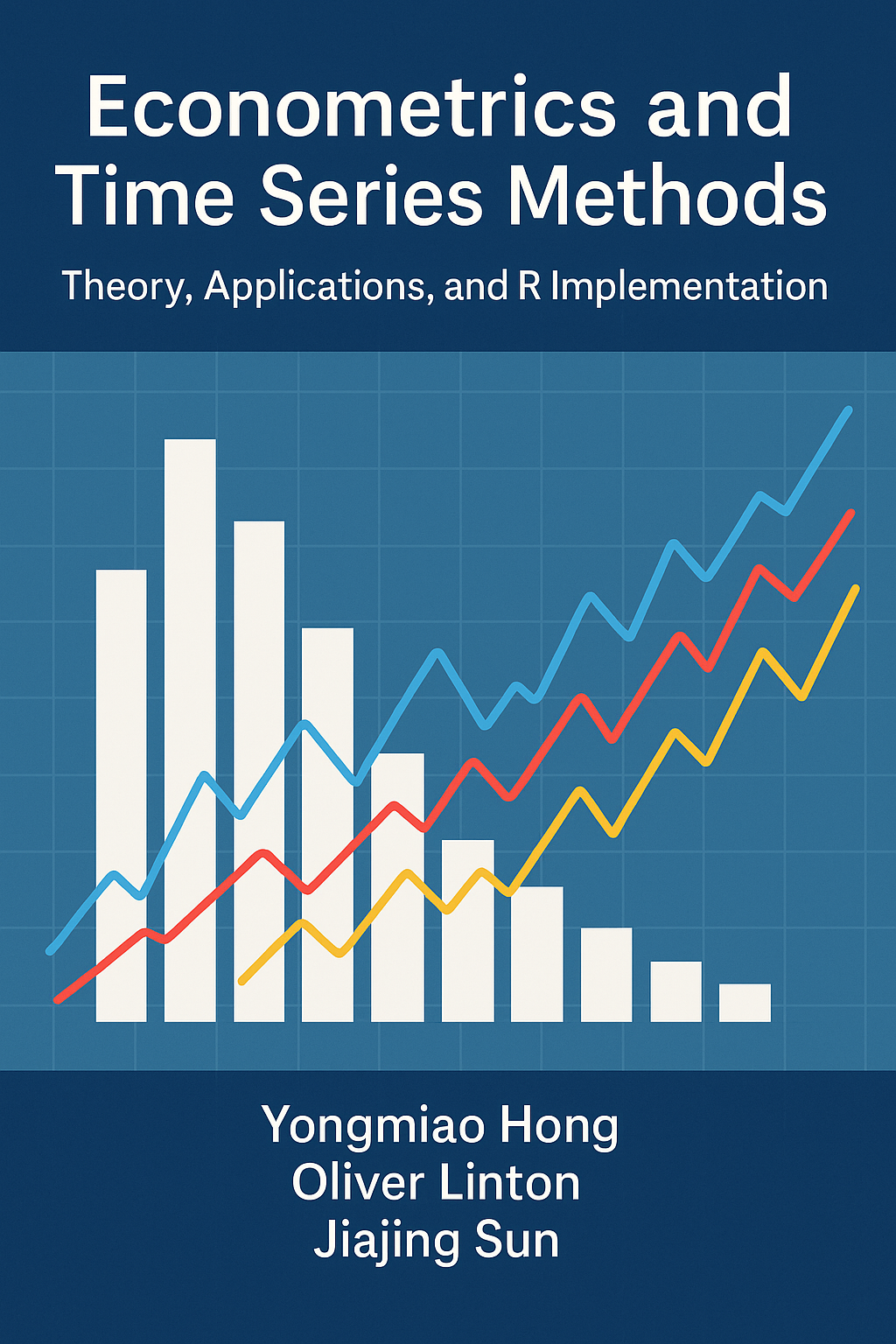
These slides accompany Chapter 4 (“Volatility Models”) of the book
Yongmiao Hong, Oliver Linton, Jiajing Sun
Econometrics and Time Series Methods: Theory, Applications, and R Implementation.
The slides provide a focused introduction to modeling and forecasting time‐varying volatility, with particular emphasis on financial time series. They motivate why volatility matters in econometrics and finance, and introduce key empirical features such as volatility clustering, heavy tails, and leverage effects. Core topics typically include the ARCH and GARCH families of models and their extensions, properties of conditional variance dynamics, parameter restrictions for positivity and stationarity, and the behavior of conditional and unconditional moments. The slides also cover estimation and inference (for example maximum likelihood and quasi–maximum likelihood), model diagnostics, volatility forecasting, and applications to risk management and asset pricing.
In keeping with the book’s integration of theory, applications, and computation, the slides link the formal econometric framework for volatility models with practical implementation in R. They illustrate how to estimate volatility models, interpret the fitted conditional variance, produce and evaluate volatility forecasts, and compare competing specifications in empirical work. The material is suitable for advanced undergraduate and graduate teaching and can be directly used or adapted by instructors.
Unless otherwise indicated, the slides are shared under the Creative Commons Attribution–NonCommercial 4.0 International License (CC BY-NC 4.0). Readers and instructors who wish to
Courses that include this CL
Recommended for you




Meet the instructors !
