



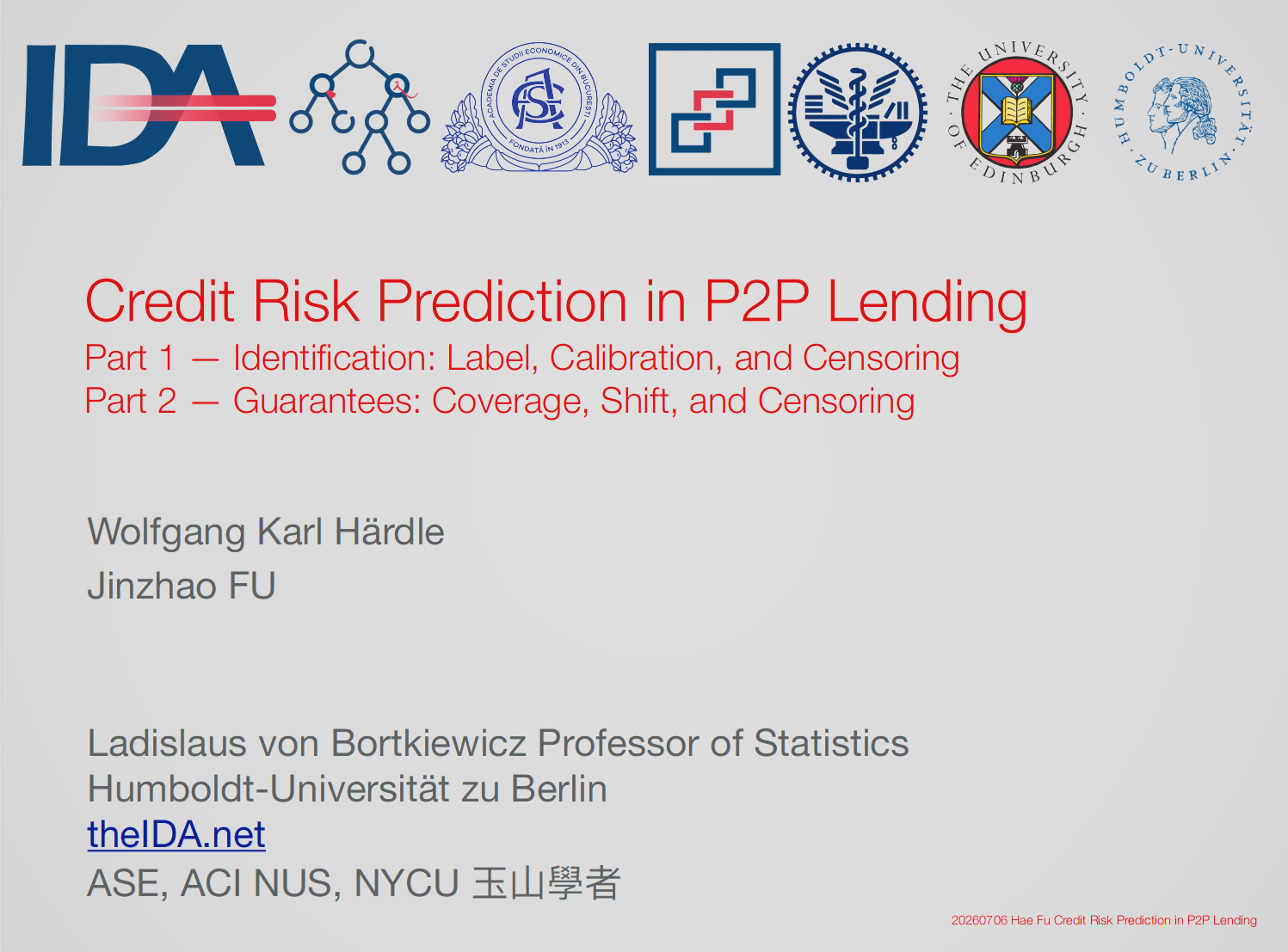
Credit Risk in P2P Lending (pdf)
Credit Risk Prediction in P2P Lending
-
- 0 Rating
- 0 Reviews
- 2 Students Enrolled
Credit Risk Prediction in P2P Lending
Credit Risk Prediction in P2P Lending
-
- 0 Rating
- 0 Reviews
- 2 Students Enrolled
Courselet Content
2 components
|
|
10.8 M | |
|
Credit Risk in P2P Lending (video)
|
36 min |
Requirements
- Credit Risk in P2P Lending
General Overview
Description
This presentation examines credit risk prediction in peer-to-peer lending, focusing on how default definitions, prediction horizons, and censoring affect model evaluation. Using Bondora loan data, it compares Logistic Regression, LightGBM, TabPFN-3, and the platform’s own probability-of-default score across ranking, calibration, and loss metrics. The analysis shows that strong predictive performance does not necessarily imply reliable probability estimates, particularly when labels or evaluation samples change. The second part introduces conformal prediction as a framework for producing valid uncertainty sets under explicit assumptions. It considers marginal and country-specific coverage, distribution shift, online adaptation, censoring, and robustness to alternative default definitions. Finally, uncertainty sets are translated into lending decisions through false-discovery-rate-controlled approval rules. Overall, the presentation argues that reliable credit-risk inference requires not only accurate models, but also clearly defined targets, transparent assumptions, and measurable costs of uncertainty.
Recommended for you




Meet the instructors !