



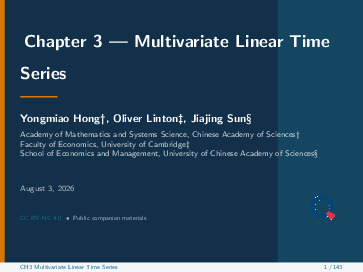
Chapter 3: Multivariate Linear Time Series (Slides) (pdf)
Chapter 3: Multivariate Linear Time Series
-
- 0 Rating
- 0 Reviews
- 7 Students Enrolled
Chapter 3: Multivariate Linear Time Series
Slides for Chapter 3 “Multivariate Linear Time Series” from Hong, Linton, and Sun, Econometrics and Time Series Methods: Theory, Applications, and R Implementation. The slides introduce VAR/VMA/VARMA models and tools for analysing dynamic interactions among multiple time series, suitable for advanced undergraduate and graduate students.
-
- 0 Rating
- 0 Reviews
- 7 Students Enrolled
Courselet Content
2 components
|
|
804.7 K | |
|
Chapter 3: Multivariate Linear Time Series (Slides) (video)
|
60 min |
Requirements
- Solid background in basic calculus, linear algebra, and introductory probability and statistics. Familiarity with linear regression and univariate time series analysis (e.g., material from Chapters 1 and 2) is recommended. Basic R experience is helpful for following the implementation examples.
General Overview
Description
Chapter 3
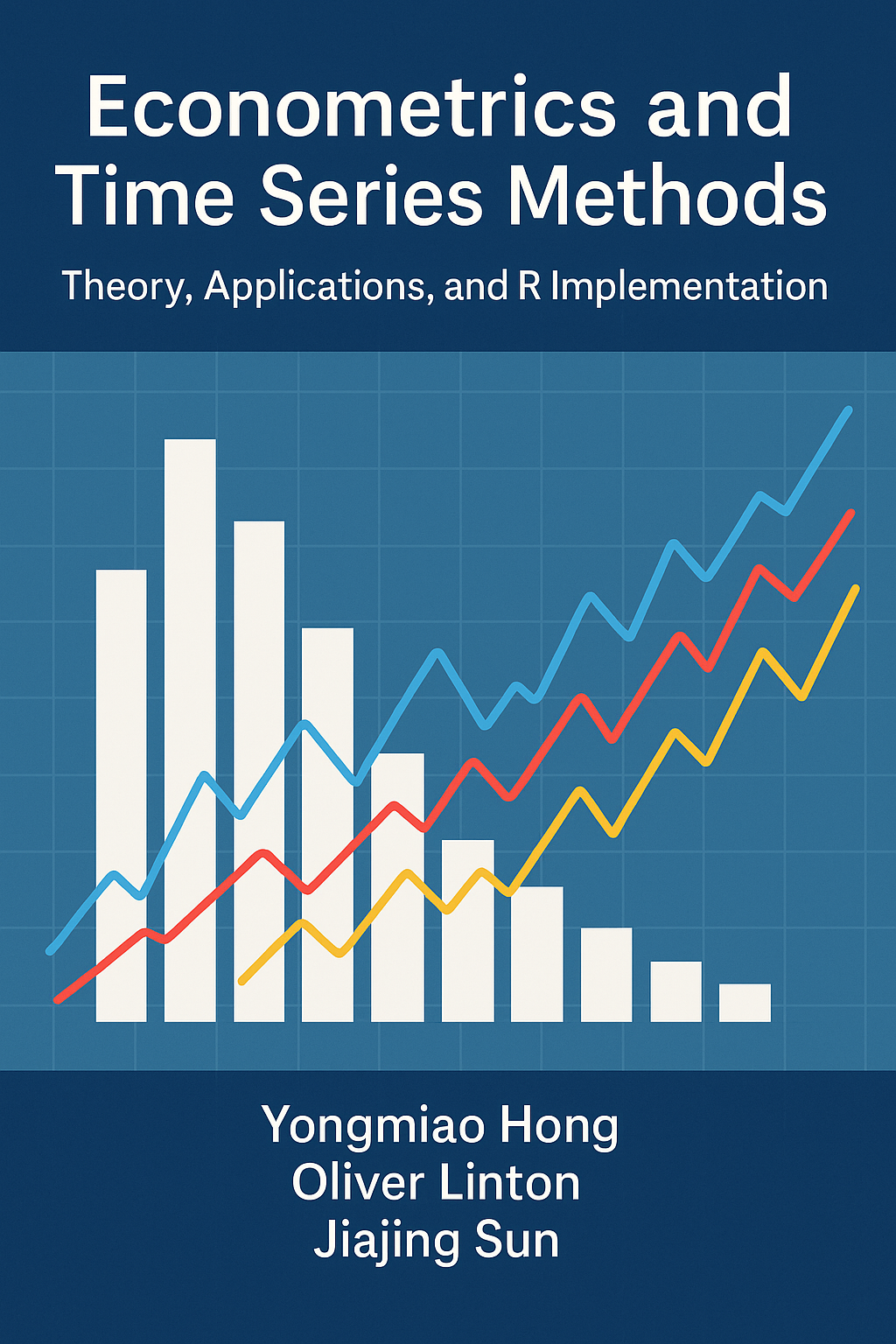
These slides accompany Chapter 3 (“Multivariate Linear Time Series”) of the book
Yongmiao Hong, Oliver Linton, Jiajing Sun
Econometrics and Time Series Methods: Theory, Applications, and R Implementation.
The slides provide a structured introduction to multivariate linear time series analysis, focusing on how multiple time series evolve jointly over time. They build on the univariate theory to develop key concepts and tools for analyzing dynamic interactions among several variables. Core topics typically include vector-valued stochastic processes, second-order properties of multivariate time series, vector autoregressive (VAR) and vector moving average (VMA) models, and their VARMA representations. The slides also discuss issues such as model specification, stability and stationarity conditions, impulse–response analysis, and forecasting in a multivariate setting.
Consistent with the book’s emphasis on integrating theory, applications, and computation, the slides link the underlying econometric theory to practical implementation in R. They illustrate how to estimate VAR-type models, interpret dynamic relationships (including lead–lag structure and Granger-type predictive relationships), and evaluate model fit and forecast performance in empirical applications. The material is suitable for advanced undergraduate and graduate courses and can be directly used or adapted by instructors.
Unless otherwise indicated, the slides are shared under the Creative Commons Attribution–NonCommercial 4.0 International License (CC BY-NC 4.0). Readers and instructors who wish to request the LaTeX source files or provide feedback are welcome to contact us at jiajing.sun@gmail.com.
Courses that include this CL
Recommended for you


Meet the instructors !
